
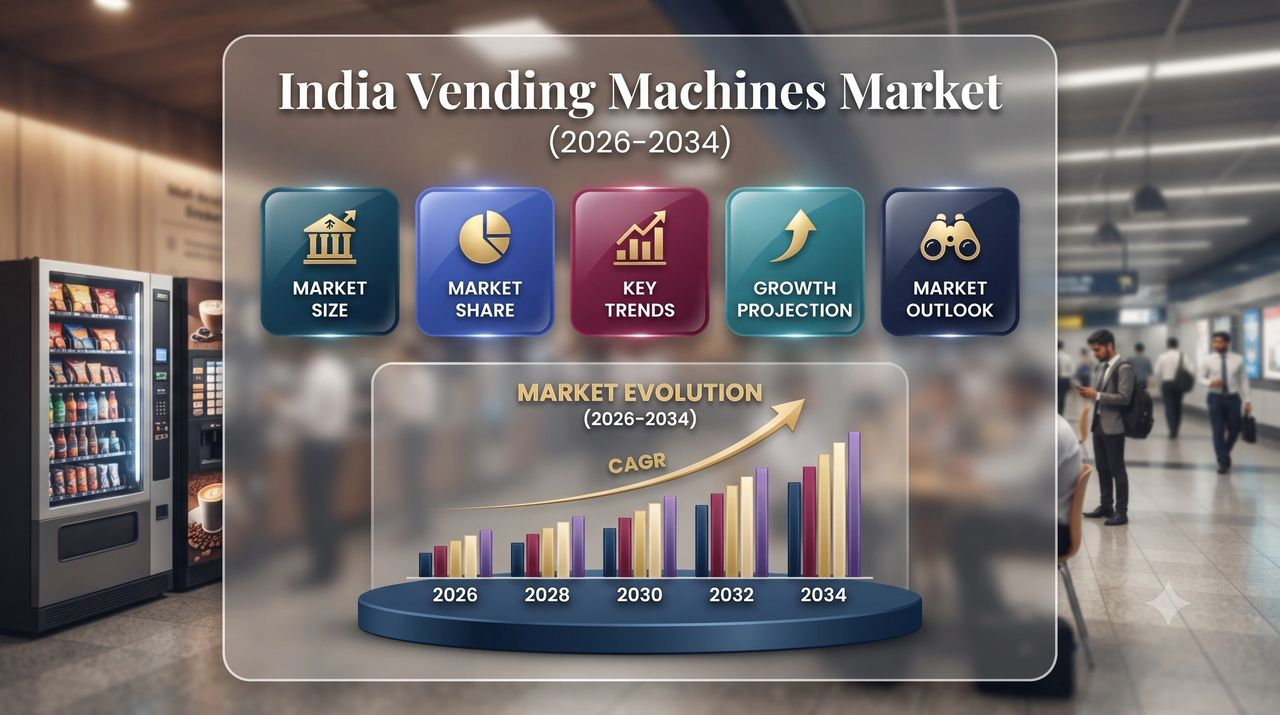
According to IMARC Group’s report titled “India Vending Machines Market Size, Share, Trends and Forecast by Type, Technology, Payment Mode, Application, and Region, 2026-2034“, the report offers a comprehensive analysis of the industry, including market trends, share, forecast and regional insights.
Market Outlook
The India vending machines market size reached USD 728.2 Million in 2025. Looking forward, IMARC Group expects the market to reach USD 1,041.7 Million by 2034, exhibiting a growth rate (CAGR) of 3.94% during 2026-2034. The market is driven by the rising demand for vending machines in offices, hotels, and public spaces. Moreover, the increasing adoption of smart, cashless, and automated machines, and vending machines offering nutritious options is driving installations of vending machines across India.
High-Intent Baseline Data
- Market Value (2025): USD 728.2 Million
- Forecast Market Value (2034): USD 1,041.7 Million
- CAGR (2026-2034): 3.94%
- Base Year: 2025
- Forecast Years: 2026-2034
- Historical Years: 2020-2025
What are the Key Developments and Emerging Shifts in the India Vending Machines Market?
- The UPI & Cashless Payment Revolution: The domestic automated retail landscape is executing a massive structural shift away from coin and cash-operated legacy systems. By aggressively integrating Unified Payments Interface (UPI), QR codes, and digital wallets, manufacturers are eliminating the severe operational bottlenecks of cash handling and coin jams. This critical technological intervention drastically reduces transaction friction, ensuring highly resilient, continuous institutional and public procurement.
- "Intelligent Vending" and IoT Telematics: The market is rapidly evolving far beyond traditional snack dispensing. The mass integration of Internet of Things (IoT) sensors and cloud-based telematics allows operators to monitor real-time inventory levels, track machine health, and analyze localized consumption patterns. This structural optimization systematically eradicates out-of-stock scenarios and heavily minimizes physical maintenance rounds.
- Nutritional Premiumization and Clean Labels: Driven by intense urban health consciousness, operators are radically upgrading their product assortments. The industry is actively replacing conventional sugary snacks with healthy, high-protein granola bars, cold-pressed juices, and herbal teas. This shift is crucial for securing lucrative contracts in corporate offices, premium gyms, and modern educational institutions.
- Diversification into Non-Traditional FMCG: The concept of vending is structurally expanding beyond food and beverages. Emerging startups are aggressively deploying specialized smart kiosks for feminine hygiene products, innerwear, industrial PPE, and even educational books in transit hubs and corporate parks. This massive diversification maximizes the commercial utility of automated retail footprints.
- Corporate Micro-Markets and Office Pantries: The widespread execution of hybrid work models heavily dictates the structural evolution of B2B facility management. Corporate real estate operators are aggressively replacing full-service cafeterias with automated, unmanned micro-markets and tabletop coffee machines, systematically optimizing overhead costs while providing 24/7 refreshment access to employees.
What Factors are Driving Growth in the India Vending Machines Market?
- The aggressive expansion of India’s modern transit infrastructure—specifically the rapid development of Tier-1 and Tier-2 metro rail networks and privatized airports—acts as a massive primary structural growth catalyst. These high-footfall transit corridors actively force the mass integration of convenient, on-the-go refreshment solutions, driving unprecedented institutional procurement continuously.
- Intensive digital democratization through the national UPI framework heavily incentivizes the adoption of automated retail. The structural capability to execute secure, micro-transactions in under 10 seconds compels massive urban demographics to confidently utilize vending machines, completely bridging the historical trust deficit associated with machine malfunctions.
- The widespread expansion of organized corporate real estate and IT/ITES parks aggressively dictates the structural expansion of B2B vending deployments. With immense reliance on employee wellness and productivity, facility managers systematically create a highly structured demand pipeline for automated beverage and snack dispensers.
- Surging structural modernization within the domestic retail and fast-moving consumer goods (FMCG) sectors heavily stimulates omnichannel expansion. Major FMCG brands are actively deploying direct-to-consumer (D2C) smart vending machines as experiential marketing touchpoints, heavily boosting specialized commercial deployment continuously.
- Rising urbanization and the fast-paced lifestyles of dual-income households heavily incentivize the adoption of instant gratification retail. The structural demand for immediate, 24/7 access to packaged food and beverages directly ensures continuous high-volume retail transactions across urban nodes.
➤ Request Sample Report – TOC, Charts & Key Insights: https://www.imarcgroup.com/india-vending-machines-market/requestsample
How Is the Market Segmented?
Type Insights:
- Food Vending Machine
- Beverages Vending Machine
- Tobacco Vending Machine
- Others
Technology Insights:
- Automatic Machine
- Semi-Automatic Machine
- Smart Machine
Payment Mode Insights:
- Cash
- Cashless
Application Insights:
- Hotels and Restaurants
- Corporate Offices
- Public Places
- Others
Regional Insights:
- North India
- South India
- East India
- West India
Recent Market Developments
- In early 2024, Pearson India aggressively launched automated book vending machines in Bengaluru, integrating high-speed UPI payments to structurally modernize access to educational materials in corporate and institutional spaces.
- Innovative D2C apparel startups, such as Bummer, structurally executed massive expansions into automated retail by deploying specialized innerwear vending machines at major transit hubs like Ahmedabad Airport, legally securing high-visibility consumer touchpoints.
- Major facility management and vending operators systematically accelerated the deployment of IoT-enabled, cashless tabletop coffee and fresh milk vending machines across premium IT parks in Mumbai and Delhi-NCR, fundamentally upgrading corporate pantry operations.
The CXO Blindspot:
While retail and facility executives aggressively deploy legacy, coin-operated or offline vending machines to capture immediate footfall, a critical oversight remains regarding the severe structural vulnerabilities exposed by poor inventory visibility and payment friction. Treating vending purely as static mechanical dispensers rather than aggressively upgrading to IoT-enabled, 100% UPI-compliant "Intelligent Kiosks" leaves enterprises massively exposed to high machine downtime, cash-pilferage, and severe consumer abandonment when digital payment options fail.
Competitive Landscape
Covering an in-depth analysis of the competitive landscape, market structure, key player positioning, competitive dashboards, top winning strategies, and detailed profiles of all major industry participants you will gain access to all these exclusive insights within the full research report.
Customization Note: If you require any specific information not covered within this report's scope, we will provide it as part of the customization.
➤ Request Report Customization: https://www.imarcgroup.com/request?type=report&id=31036&flag=E
Frequently Asked Questions (FAQs)
1. How big is the India vending machines market?
According to IMARC Group, the India vending machines market size reached USD 728.2 Million in 2025.
2. What is the expected market growth by 2034?
IMARC Group expects the overall market to reach USD 1,041.7 Million by 2034, exhibiting a steady compound annual growth rate (CAGR) of 3.94% during the 2026-2034 forecast period.
3. Which product segment dictates the market demand?
Beverages vending machines command the absolute dominant position, heavily driven by the massive corporate demand for coffee, tea, and packaged cold hydration solutions in tropical climates.
4. What are the key factors driving the market?
According to IMARC Group, the market is heavily propelled by the rapid adoption of cashless UPI payments, expanding corporate and public infrastructure, and the surging integration of smart, IoT-enabled inventory management systems.
5. Which application holds the largest market share?
Corporate offices and institutions represent the primary deployment zones, as facility managers aggressively seek automated, 24/7 refreshment solutions to optimize traditional cafeteria overheads.
Strategic Insight & Verdict:
The India vending machines market is executing a massive structural expansion fundamentally engineered by the intersection of the national UPI revolution and smart supply chain telematics. As corporate offices demand healthy, automated micro-markets and transit hubs modernize their retail footprint, historical reliance on cash-based, unmonitored machines is permanently vanishing. For corporate stakeholders, mandated integration of cloud-based inventory analytics and frictionless digital payment gateways successfully secures a highly lucrative, permanently optimized environment for automated retail investments.