
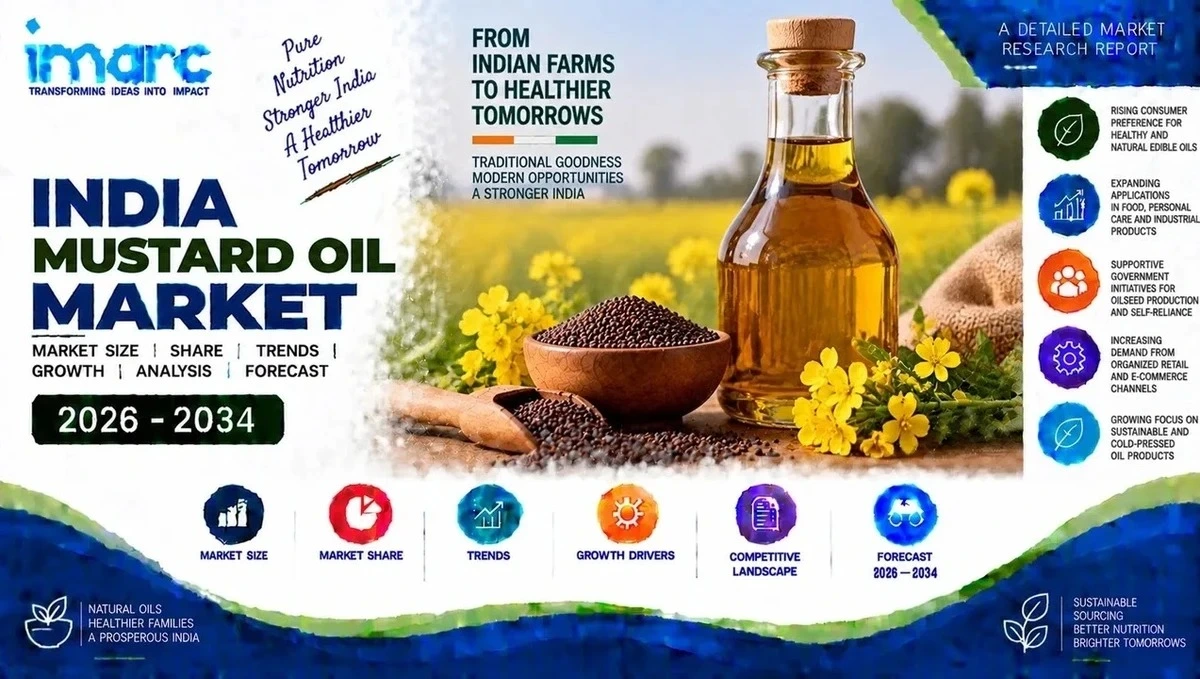
According to IMARC Group’s report titled “India Mustard Oil Market Size, Share, Trends and Forecast by Packaging Type, Packaging Material, Pack Size, Application, Distribution Channel, and Region, 2026-2034“, the report offers a comprehensive analysis of the industry, including market share, forecast, growth and regional insights.
Market Overview & Summary
The mustard oil market in India size was valued at USD 1.3 Billion in 2025 and is projected to reach USD 1.8 Billion by 2034, growing at a compound annual growth rate of 4.03% from 2026-2034. India’s essential agricultural processing and edible oil retail sectors are undergoing a significant structural realignment as consumer demand pivots decisively toward pure, minimally processed, and clean-label therapeutic cooking mediums. Driven by expanding health consciousness across urban populations and a targeted sovereign push for self-sufficiency in domestic oilseed production, the manufacturing and supply chain infrastructure for brassica-derived lipids have transitioned from local open-market commodities into a highly formalized, high-yield asset class for Fast-Moving Consumer Goods (FMCG) conglomerates and institutional food sector investors.
What are the Key Developments and Emerging Shifts in the India Mustard Oil Market?
Agro-Processing Cluster Expansion: The implementation of the Pradhan Mantri Kisan SAMPADA Yojana facilitates the development of modern agro-processing clusters across the nation. By providing capital grants for specialized oil extraction facilities, this scheme reduces post-harvest agricultural losses. It ensures a stable supply chain of raw materials for processors, directly boosting domestic mustard oil production capacity and market resilience.
Food Processing Financial Assistance: The Production Linked Incentive scheme for the food processing industry significantly accelerates domestic mustard oil manufacturing capabilities. By offering targeted financial rewards based on incremental sales and capital investment, the government actively encourages enterprises to expand their extraction operations. This policy intervention successfully cultivates larger manufacturing volumes while promoting global quality compliance.
Micro Enterprise Upgradation Focus: Through the PMFME scheme, the government empowers unorganized micro food processing enterprises by providing essential seed capital and technical training. This crucial initiative enables local farmers and self-help groups to upgrade their regional mustard oil manufacturing units. Consequently, localized processing infrastructure experiences enhanced operational efficiency and product quality, contributing directly to broader market expansion.
Powered by Personal & Corporate Gifting: Edible oil processing enterprises increasingly adopt digital and NFC business cards as personal and corporate gifts to modernize networking. Aligned with the Digital India mission, utilizing these smart branded cards for employees and clients enhances professional outreach. This technological transition minimizes paper usage while fostering seamless credential sharing across supply chains and wholesale distribution networks.
Export Infrastructure Enhancement: The Make in India initiative systematically encourages domestic mustard oil manufacturers to elevate their processing standards for international markets. Government authorities are establishing robust guidelines and certification processes to guarantee high-quality agricultural output. This strategic development allows local exporters to meet rigorous global food safety requirements, thereby increasing their penetration into overseas markets steadily.
What Factors are Driving Growth in the India Mustard Oil Market?
Oilseed Development Programs: The National Food Security Mission for Oilseeds serves as a primary growth driver by significantly expanding national mustard cultivation. Through direct financial assistance and technological support to farmers, the initiative ensures a consistent yield of oilseeds. This robust agricultural output secures a reliable raw material base, allowing oil manufacturers to maintain uninterrupted processing cycles.
Minimum Support Price Interventions: Substantial agricultural procurement mechanisms under the PM-AASHA framework successfully mitigate seasonal raw material price volatility. By guaranteeing fair remuneration for mustard seed cultivators, the government ensures a continuous supply of domestic oilseeds. This pricing stability ensures that extraction facilities operate at optimal capacities throughout the year without seasonal disruptions or extreme raw material shortages.
Foreign Direct Investment Liberalization: The allowance of unrestricted foreign direct investment under the automatic route for the food processing sector dramatically transforms the industrial landscape. This open investment framework attracts substantial global capital and advanced extraction technologies into the country. The steady influx of international funding and technical expertise rapidly accelerates domestic manufacturing modernization and broadens market reach.
Promotion of Organic Farming: The Paramparagat Krishi Vikas Yojana actively supports farmers in adopting chemical-free cultivation practices through structured financial assistance. This agricultural initiative yields premium organic mustard seeds that appeal to health-conscious consumers. The government-backed organic certification process fosters buyer trust, driving substantial value growth and premium pricing strategies within the specialized organic mustard oil manufacturing segment.
MSME Sector Empowerment: The active support provided by the Ministry of Micro, Small and Medium Enterprises enables regional processors to access affordable credit and technological upgrades. By standardizing physical assets and promoting modern manufacturing adoption, the policy lowers barriers to market entry. This regulatory backing empowers smaller manufacturers to distribute quality mustard oil competitively across domestic sectors.
➤ Request Sample Report – TOC, Charts & Key Insights: https://www.imarcgroup.com/india-mustard-oil-market/requestsample
Deep-Dive Segment Insights:
Packaging Type Insights:
- Pouches
- Jars
- Cans
- Bottles
Pouches dominates with a market share of 52% of the total market in 2025.
Packaging Material Insights:
- Metal
- Plastic
- Paper
- Others
Plastic leads with a share of 67% of the total market in 2025.
Pack Size Insights:
- Less than 1 Litres
- 1 Litres
- 1 Litres - 5 litres
- 5 Litres - 10 Litres
- 10 Litres and Above
1 litres exhibit a clear dominance with a 36% share of the total market in 2025.
Application Insights:
- Household Cooking
- HoReCa
- Industrial Uses
Household cooking dominates with a market share of 67% of the total market in 2025.
Distribution Channel Insights:
- Direct/Institutional Sales
- Supermarkets and Hypermarkets
- Convenience Stores
- Online
- Others
Convenience stores lead with a share of 43% of the total market in 2025.
Regional Insights:
- North India
- West and Central India
- East India
- South India
North India dominates with a market share of 31% of the total market in 2025.
Recent Market Developments
- The Ministry of Agriculture aggressively expanded NMEO-OS financial allocations, rapidly securing massive localized capital subsidies to heavily boost high-yield domestic mustard seed cultivation.
- FSSAI strictly enforced the complete prohibition of mustard oil blending, legally mandating absolute product purity to successfully eradicate nationwide market adulteration completely.
- ICAR actively deployed advanced, climate-resilient mustard seed varieties, guaranteeing heavily stabilized raw material availability for massive commercial oil extraction industries continually.
Competitive Landscape & Key Player Positioning:
Covering an in-depth analysis of the competitive landscape, market structure, key player positioning, competitive dashboards, top winning strategies, and detailed profiles of all major industry participants you will gain access to all these exclusive insights within the full research report.
Some of the key players include:
- Adani Wilmar Limited
- Emami Agrotech Ltd.
- Marico Limited
- Dabur India Ltd.
- Patanjali Ayurved Limited
- K. S. Oils Limited
- Puri Oil Mills Limited
- Bansal Oil Mill Ltd.
- NatureLand Organics
Customization Note: If you require specific data we can provide it as part of our customization services.
➤ Request Report Customization: https://www.imarcgroup.com/request?type=report&id=2404&flag=E
Frequently Asked Questions (FAQs)
1. How big is the India mustard oil market?
According to IMARC Group, the India mustard oil market size reached USD 1.3 Billion in 2025.
2. What is the expected market growth by 2034?
IMARC Group expects the market to reach USD 1.8 Billion by 2034, exhibiting a CAGR of 4.03%.
3. Which application leads the domestic market?
According to IMARC Group, household cooking dominates the market, capturing a massive 67% share in 2025.
4. What is the preferred packaging material?
IMARC Group identifies plastic as the leading packaging material, holding a 67% market share due to its durability and cost-effectiveness.
5. Which distribution channel commands the largest share?
According to IMARC Group, convenience stores lead the distribution segment, accounting for a 43% market share in 2025.
Strategic Insight & Verdict
The India mustard oil market is executing a massive structural transformation strictly engineered by aggressive FSSAI purity mandates and NMEO-OS cultivation frameworks. As the government rigorously enforces unblended production and subsidizes regional micro-processing units, historical reliance on adulterated oils is permanently vanishing. For corporate stakeholders, state-backed agricultural infrastructure secures a highly lucrative environment optimized for premium, cold-pressed commercial extraction investments.