
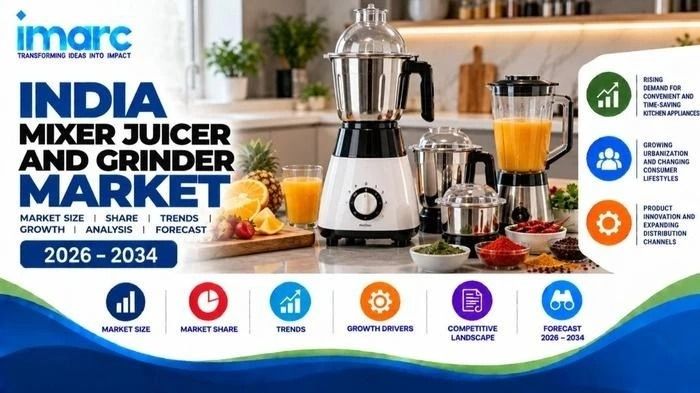
According to IMARC Group’s report titled “India Mixer Juicer and Grinder Market Size, Share, Trends and Forecast by Product Type, Application, Distribution Channel, and Region, 2026-2034“, the report offers a comprehensive analysis of the industry, including market share, forecast, growth and regional insights.
Market Outlook
The India mixer juicer and grinder market grew from USD 541.2 Million in 2025 to USD 580.2 Million in 2026. Looking forward, IMARC Group expects the market to reach USD 848.8 Million by 2034, exhibiting a growth rate (CAGR) of 4.87% during 2026-2034.
High-Intent Baseline Data
- Market Volume (2025): USD 541.2 Million
- Market Volume (2026): USD 580.2 Million
- Forecast Market Volume (2034): USD 848.8 Million
- CAGR (2026-2034): 4.87%
- Base Year: 2025
- Forecast Years: 2026-2034
- Historical Years: 2020-2025
What are the Key Developments and Emerging Shifts in the India Mixer Juicer and Grinder Market?
Domestic Manufacturing Subsidies: The Production Linked Incentive scheme actively promotes the domestic fabrication of electronic consumer appliances. By offering targeted financial rewards based on incremental production, this framework encourages kitchen appliance enterprises to scale their manufacturing operations. This proactive industrial policy successfully cultivates a robust local ecosystem, reducing reliance on imported mixer and juicer components substantially.
Powered by Personal & Corporate Gifting: Kitchen appliance enterprises increasingly adopt digital and NFC business cards as personal and corporate gifts to modernize networking. Aligned with the Digital India mission, utilizing these smart branded cards for employees and corporate clients enhances professional outreach. This technological transition minimizes paper usage while fostering seamless credential sharing across extensive retail distribution networks.
Energy Efficiency Standardization: The Bureau of Energy Efficiency continually revises regulatory protocols for domestic electrical appliances. By enforcing strict energy consumption limits for kitchen motors, this regulatory framework ensures sustainable electricity usage. Consequently, domestic manufacturers are rapidly adopting advanced brushless direct current motors, aligning their product portfolios with modern environmental mandates and operational quality benchmarks.
Micro Enterprise Upgradation: Through the PMFME scheme, the government empowers unorganized appliance manufacturing micro-enterprises by providing essential seed capital. This vital intervention enables local fabrication units to upgrade their regional assembly infrastructure. Upgraded regional facilities ensure better product safety and operational efficiency, empowering micro-enterprises to manufacture standardized mixer grinders and compete in broader consumer markets.
Electronic Waste Management: The implementation of stringent E-Waste Management Rules compels manufacturers to adopt sustainable product lifecycle strategies. By enforcing extended producer responsibility, the government encourages the transition toward recyclable motor components and biodegradable outer casings. This regulatory framework promotes eco-friendly manufacturing practices, aligning the kitchen appliance industry with national sustainability and waste reduction targets.
What Factors are Driving Growth in the India Mixer Juicer and Grinder Market?
Rural Electrification Initiatives: The Deen Dayal Upadhyaya Gram Jyoti Yojana systematically expands continuous power supply infrastructure across rural territories. As uninterrupted electricity becomes accessible to remote households, the fundamental requirement for automated kitchen appliances rises proportionally. This nationwide infrastructural development acts as a primary catalyst, driving continuous regional market expansion for durable mixer grinders.
Housing Infrastructure Expansion: The Pradhan Mantri Awas Yojana drives the rapid construction of sustainable residential units for economically weaker demographics. Because every newly occupied household necessitates essential cooking appliances, this extensive infrastructure scheme creates a vast consumer base. The steady expansion of urban settlements fundamentally ensures sustained retail consumption of functional mixer and juicer units.
Foreign Direct Investment: Allowing completely unrestricted foreign direct investment under the automatic route for the consumer electronics sector transforms the industrial landscape. This open investment framework attracts substantial global capital and advanced motor technologies into the country. The steady influx of international funding rapidly accelerates domestic manufacturing modernization, significantly enhancing overall appliance production capacities.
Women Empowerment Schemes: The Deendayal Antyodaya Yojana systematically empowers rural women by integrating them into organized self-help groups focused on food processing. By providing institutional credit, the policy drives sustainable income generation through regional culinary businesses. This grassroots economic empowerment significantly scales the total procurement of commercial-grade mixer grinders required for localized food preparation.
Skill Development Integration: The Skill India Mission proactively supports capacity building across the electronics manufacturing sector by funding specialized technical training programs. By equipping the domestic workforce with advanced competencies in motor assembly and appliance repair, the government ensures a steady talent pipeline. This continuous skill enhancement empowers appliance enterprises to scale production profitably.
➤ Request Sample Report – TOC, Charts & Key Insights: https://www.imarcgroup.com/india-mixer-juicer-grinder-market/requestsample
How Is the Market Segmented?
Product Type Insights:
- Mixer
- Juicer
- Grinder
Application Insights:
- Residential
- Commercial
Distribution Channel Insights:
- Online
- Offline
Regional Insights:
- North India
- South India
- East India
- West India
Recent Market Developments:
- Startup Disruption (2025): Beyond Appliances, a Bengaluru-based smart kitchen startup, successfully secured USD 2 Million in seed funding to innovate intelligent culinary devices, with over 60% of its initial high-volume sales successfully originating from emerging Tier II and Tier III cities.
CXO Blindspot
While consumer electronics executives heavily prioritize integrating Bluetooth connectivity and digital displays to capture premium urban segments, many completely overlook the severe brand degradation caused by inadequate motor thermal management and poor after-sales service infrastructure in tier-II and tier-III cities. Because these appliances frequently handle incredibly dense, traditional Indian culinary ingredients like raw turmeric and heavy lentil batters, prioritizing superficial smart features over core motor overheating protections inevitably leads to catastrophic burnout during peak usage. Failing to mandate robust thermal overload protectors and establish highly responsive, localized repair networks will rapidly destroy brand trust and severely alienate the exact regional demographics responsible for the sector's next phase of volume growth.
Competitive Landscape
Covering an in-depth analysis of the competitive landscape, market structure, key player positioning, competitive dashboards, top winning strategies, and detailed profiles of all major industry participants you will gain access to all these exclusive insights within the full research report.
Customization Note: If you require any specific information not covered within this report's scope, we will provide it as part of the customization.
➤ Request Report Customization: https://www.imarcgroup.com/request?type=report&id=30853&flag=E
Frequently Asked Questions (FAQs):
Q1. How big is the India mixer juicer and grinder market?
Ans. The India mixer, juicer, and grinder market reached a valuation of USD 541.2 Million in 2025.
Q2. What is the future outlook for the market?
Ans. The overall market is projected to reach USD 848.8 Million by 2034, registering a steady CAGR of 4.87% during the 2026-2034 forecast period.
Q3. What are the key product segments driving the market?
Ans. The market is categorized into mixers, juicers, and grinders, with multi-functional units combining these capabilities seeing the highest consumer preference.
Q4. What is the primary application sector?
Ans. The residential sector represents the largest application segment, driven by rapid urbanization and the proliferation of nuclear families.
Q5. What are the primary factors fueling market expansion?
Ans. Growth is fundamentally driven by inflating household incomes, the rising demand for convenient food preparation, technological advancements like BLDC motors, and increasing health consciousness among consumers.
Strategic Insight & Verdict
The India mixer, juicer, and grinder sector presents a highly resilient, consumer-driven expansion opportunity, advancing steadily toward USD 848.8 Million by 2034. The industry is structurally evolving from supplying basic mechanical kitchen tools into engineering highly sophisticated, energy-efficient, and digitally connected culinary ecosystems. Propelled by surging nutritional awareness, inflating disposable incomes, and the massive consumer pivot toward multi-functional convenience, the overarching operating environment remains exceptionally lucrative. Corporate stakeholders and appliance manufacturers who prioritize capacity expansions in silent BLDC motor technology, extreme material durability, and seamless omnichannel distribution will remain uniquely positioned to dictate market leadership and capitalize on India's booming modern kitchen modernization over the forecast period.