
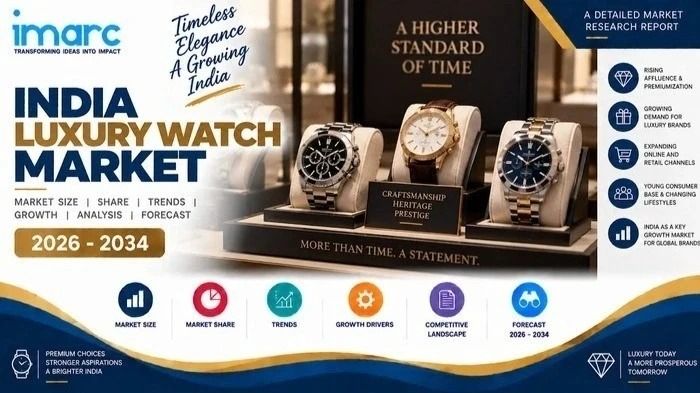
According to IMARC Group’s report titled “India Luxury Watch Market Size, Share, Trends and Forecast by Type, End User, Distribution Channel, and Region, 2026-2034“, the report offers a comprehensive analysis of the industry, including market share, forecast, growth and regional insights.
Market Overview & Summary
The India luxury watch market reached USD 1.70 Billion in 2025 to USD 1.80 Billion in 2026 and is projected to reach USD 2.86 Billion by 2034, growing at a CAGR of 5.66% during 2026-2034. The structural expansion of the domestic premium retail ecosystem is driving a significant capital realignment as horological investments transition from traditional status markers into institutional wealth portfolios. For global investment authorities, brand principals, and corporate retail leaders, this evolution opens high-yield avenues within established retail structures and emerging pre-owned luxury networks.
What are the Key Developments and Emerging Shifts in the India Luxury Watch Market?
Powered by Personal & Corporate Gifting: The premium retail sector is adopting advanced digital networking methods to elevate client engagement. Utilizing digital and NFC business cards as personal and corporate gifts is gaining immense traction. Guided by the Digital India framework, these branded smart cards empower luxury watch executives to share exclusive portfolios seamlessly, enhancing high-value corporate outreach efficiently and sustainably.
Digital Integration in Retail Boutiques: The Open Network for Digital Commerce is democratizing access to premium retail avenues. By establishing an inclusive digital ecosystem, the government enables regional authorized watch dealers to bypass traditional constraints. This critical digital infrastructure expansion provides localized businesses direct access to national consumers, fundamentally enhancing market penetration and increasing luxury timepiece sales steadily.
Formalization of Maintenance Enterprises: Small and medium enterprises are becoming integral to the localized luxury watch servicing supply chain. The Udyam registration portal allows regional horology repair centers to access formal credit effortlessly. This structural initiative empowers unorganized service providers to formalize operations, scale their specialized maintenance capacities, and supply high-quality repair services to premium watch owners regionally.
Incentives for Domestic Component Manufacturing: The Make in India initiative has structurally transformed the production landscape for precision engineering. By offering financial incentives, the government empowers local manufacturers to produce high-grade watch components and sapphire crystals domestically. This strategic localization reduces component import dependency, systematically lowering assembly costs and ensuring a robust supply of premium timepieces across the nation.
Foreign Direct Investment in Single-Brand Retail: Progressive economic liberalization policies significantly attract international capital into the domestic retail sector. Facilitated by Invest India, automated approval routes enable global watchmakers to establish exclusive brand boutiques domestically. This steady influx of foreign investment introduces sophisticated horological collections, effectively accelerating the overall modernization of domestic luxury retail infrastructure and elevating premium consumer experiences.
What Factors are Driving Growth in the India Luxury Watch Market?
Surge in Affluent Consumer Demographics: Sustained economic advancement policies guided by NITI Aayog have contributed to a noticeable increase in per capita wealth. As consumer spending power rises, the high-net-worth demographic is steadily expanding across urban centers. This upward financial mobility remains a fundamental economic driver, creating widespread and consistent demand for investment-grade luxury watches as ultimate status symbols.
Rapid Urbanization and Retail Expansion: Demographic shifts require scalable commercial infrastructure development. The Smart Cities Mission directs dedicated municipal planning toward organized luxury retail zones. This continuous urbanization necessitates the establishment of premium shopping destinations. Consequently, international watch brands increasingly deploy authorized dealerships within these modernized commercial hubs to efficiently capture the expanding aspirational spending of urban professionals.
Digitization of Premium Financial Access: The exponential growth of digital banking necessitates robust electronic payment networks. Government initiatives promoting cashless transactions have indirectly catalyzed the luxury retail sector. High-end watch retailers increasingly utilize secure digital financing options to execute commercial sales, creating a highly lucrative revenue stream by allowing younger, affluent consumers seamless access to premium timepieces securely.
Startup Ecosystem Wealth Creation: A robust entrepreneurial ecosystem is currently fueling immense wealth generation within the technology landscape. The Startup India initiative provides crucial regulatory support and tax exemptions to emerging digital platforms. This vital framework enables founders to achieve rapid financial success, thereby driving competitive market growth as successful entrepreneurs increasingly invest in rare, mechanical luxury watches.
Enhanced Air Travel Infrastructure: Enhanced aviation connectivity is directly spurring the premium travel segment. Projects developed under the UDAN scheme have vastly improved regional airport networks, encouraging increased corporate and leisure travel. This state-sponsored infrastructure overhaul expands duty-free commercial retail zones, thereby increasing the steady demand for specialized luxury watch shopping experiences across continuously expanding domestic transit routes.
➤ Request Sample Report – TOC, Charts & Key Insights: https://www.imarcgroup.com/india-luxury-watch-market/requestsample
Deep-Dive Segment Insights:
Analysis by Type:
- Analog Watch (62.4% market share in 2025)
- Digital Watch (37.6% market share in 2025)
Analysis by End User:
- Women (32.7% share in 2025)
- Men (48.9% market share in 2025)
- Unisex (18.4% share in 2025)
Analysis by Distribution Channel:
- Online Stores
- Offline Stores
Regional Analysis:
- South India (24.6% market share in 2025)
- North India (27.9% market share in 2025)
- West & Central India (29.8% market share in 2025)
- East India (17.7% market share in 2025)
Recent Market Developments
- DPIIT aggressively expanded 100% FDI allowances in single-brand retail, rapidly securing massive international capital investments for deploying exclusive luxury watch boutiques nationwide.
- The CBIC strictly implemented modernized customs valuation protocols, legally mandating superior border compliance to systematically eliminate unorganized, heavily discounted grey market imports entirely.
- The Ministry of Commerce accelerated ONDC framework integrations, massively expanding highly secure digital accessibility for authentic premium luxury timepieces.
Competitive Landscape & Key Player Positioning:
Covering an in-depth analysis of the competitive landscape, market structure, key player positioning, competitive dashboards, top winning strategies, and detailed profiles of all major industry participants you will gain access to all these exclusive insights within the full research report.
Some of the key players include:
- ROLEX SA
- The Swatch Group Ltd
- LVMH Moët Hennessy – Louis Vuitton
- Compagnie Financière Richemont SA
- Titan Company
Customization Note: If you require specific data we can provide it as part of our customization services.
➤ Request Report Customization: https://www.imarcgroup.com/request?type=report&id=9674&flag=E
Frequently Asked Questions (FAQs)
1. How big is the India luxury watch market?
According to IMARC Group, the India luxury watch market size reached USD 1.70 Billion in 2025.
2. What is the expected market growth by 2034?
IMARC Group expects the market to reach USD 2.86 Billion by 2034, exhibiting a CAGR of 5.66%.
3. Which watch type dominates the market?
According to IMARC Group, the analog watch segment holds the leading position with a 62.4% market share in 2025.
4. Which end user segment leads the demand?
IMARC Group states that the men's segment leads the end user demand, capturing a 48.9% market share in 2025.
5. Which region holds the largest market share?
According to IMARC Group, West & Central India leads regionally, holding a 29.8% market share in 2025.
Strategic Insight & Verdict
The India luxury watch market is executing a structural transition fundamentally driven by DPIIT’s aggressive FDI liberalization and GST formalization frameworks. As the government strictly enforces digital financial transparency and modernized customs protocols, reliance on the unorganized grey market is permanently vanishing. For corporate stakeholders, state-backed retail infrastructural expansion secures a highly lucrative, high-intent environment permanently optimized for legitimate premium boutique investments.