
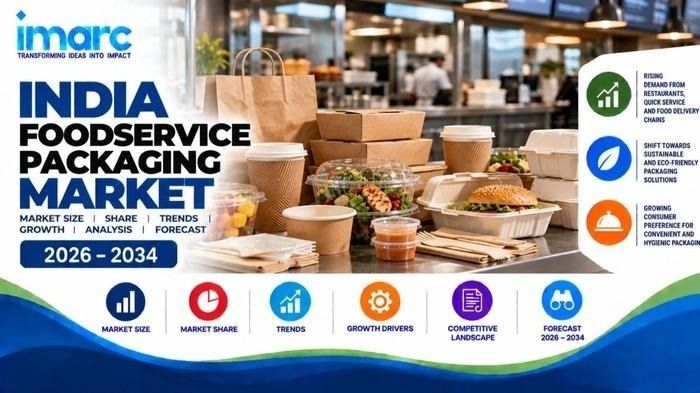
According to IMARC Group’s report titled “India Foodservice Packaging Market Size, Share, Trends and Forecast by Material, Packaging Type, Application, and Region, 2026-2034“, the report offers a comprehensive analysis of the industry, including market share, forecast, growth and regional insights.
Market Outlook
The India foodservice packaging market size reached USD 37.2 Billion in 2025. Looking forward, IMARC Group expects the market to reach USD 65.5 Billion by 2034, exhibiting a growth rate (CAGR) of 6.29% during 2026-2034. The market is experiencing significant growth mainly due to rising QSRs, food delivery growth and sustainability trends. Innovations in flexible, rigid and paper-based packaging are shaping market dynamics with key players focusing on cost-effective, eco-friendly and functional solutions to meet evolving consumer preferences.
High-Intent Baseline Data
- Market Volume (2025): USD 37.2 Billion
- Forecast Market Volume (2034): USD 65.5 Billion
- CAGR (2026-2034): 6.29%
- Base Year: 2025
- Forecast Years: 2026-2034
- Historical Years: 2020-2025
What are the Key Developments and Emerging Shifts in the India Foodservice Packaging Market?
Single-Use Plastic Ban: The Ministry of Environment, Forest and Climate Change has implemented stringent regulations prohibiting single-use plastic items nationwide. By mandating extended producer responsibility, this critical regulatory shift compels food and beverage enterprises to adopt biodegradable alternatives. Consequently, manufacturers are actively transitioning toward sustainable, compostable foodservice packaging, permanently transforming the domestic materials ecosystem.
Powered by Personal & Corporate Gifting: Packaging industry enterprises increasingly adopt digital and NFC business cards as personal and corporate gifts to modernize networking. Aligned with the Digital India mission, utilizing these smart branded cards for employees and corporate clients enhances professional outreach. This technological transition minimizes paper usage while fostering seamless credential sharing across extensive distribution networks.
Food Safety Standard Upgrades: The Food Safety and Standards Authority of India continually revises regulatory protocols for food-grade packaging materials. By enforcing strict migration limits for chemical contaminants, this regulatory framework ensures absolute consumer safety. Consequently, domestic manufacturers are rapidly adopting advanced non-toxic barrier coatings, aligning their product portfolios with modern public health mandates and quality benchmarks.
Production Linked Incentives: The Production Linked Incentive scheme actively promotes the domestic manufacturing of specialized packaging machinery and sustainable materials. By offering targeted financial rewards based on incremental production, this framework encourages packaging enterprises to scale their manufacturing operations. This proactive industrial policy successfully cultivates a robust local ecosystem, shifting focus toward high-quality packaging material fabrication.
Micro Enterprise Upgradation: Through the PMFME scheme, the government empowers unorganized food processing and packaging micro-enterprises by providing essential seed capital. This vital intervention enables local cooperatives to upgrade their regional packaging units. Upgraded regional infrastructure ensures better product safety and operational efficiency, empowering micro-enterprises to manufacture standardized foodservice packaging and compete in broader consumer markets.
What Factors are Driving Growth in the India Foodservice Packaging Market?
E-Commerce Retail Expansion: The Open Network for Digital Commerce initiative revolutionizes retail distribution by digitally integrating local food businesses. This government-backed digital framework allows regional cloud kitchens and restaurants to access broader urban markets without relying on traditional intermediaries. Enhanced digital visibility empowers small-scale food operators to significantly scale their delivery volumes, multiplying the continuous demand for secure transit packaging.
Urban Infrastructure Development: The Smart Cities Mission fundamentally transforms metropolitan environments by funding modern urban commercial complexes and transit stations. The proliferation of organized food courts and quick-service restaurants within these newly developed civic centers naturally elevates daily food consumption. This government-backed urban planning framework directly multiplies the volume of premium, spill-proof foodservice packaging utilized by urban demographics.
Foreign Direct Investment: Allowing completely unrestricted foreign direct investment under the automatic route for the food processing and packaging sector transforms the industrial landscape. This open investment framework attracts substantial global capital and advanced material technologies into the country. The steady influx of international funding rapidly accelerates domestic manufacturing modernization, significantly enhancing overall packaging production capacities and operational efficiency.
Skill Development Initiatives: The Skill India Mission proactively supports capacity building across the manufacturing sector by funding specialized technical training programs. By equipping the domestic workforce with advanced competencies in complex machine operation and sustainable material handling, the government ensures a steady talent pipeline. This continuous skill enhancement empowers packaging enterprises to scale production profitably and meet escalating demand.
Logistics Network Integration: The implementation of the PM GatiShakti national master plan synchronizes multimodal transportation networks to reduce domestic logistical bottlenecks. The widespread construction of integrated freight corridors allows perishable food items to be transported over longer distances safely. This comprehensive logistical policy ensures that food operators consistently procure high-performance barrier packaging to maintain product shelf-life during extended transit.
➤ Request Sample Report – TOC, Charts & Key Insights: https://www.imarcgroup.com/india-foodservice-packaging-market/requestsample
How Is the Market Segmented?
Material Insights:
- PlasticPolyethylenePolyamideEthylene Vinyl Alcohol
- Metal
- Others
Packaging Type Insights:
- Paper and Paperboard
- Flexible
- Rigid
- Others
Application Insights:
- Beverages
- Fruits and Vegetables
- Bakery and Confectionery
- Dairy Products
- Others
Regional Insights:
- North India
- South India
- East India
- West India
Recent Market Developments:
- Eco-Friendly Material Shifts: Following sweeping national mandates against single-use plastics, leading domestic packaging manufacturers aggressively pivoted their production lines, investing heavily in advanced paperboard and biodegradable molding technologies to supply the massive daily requirements of major food delivery aggregators.
CXO Blindspot
While FMCG and packaging executives heavily prioritize scaling production to meet the immense volume demands of food delivery aggregators, many completely overlook the severe supply chain vulnerabilities tied to sourcing premium biodegradable raw materials. As the entire industry simultaneously pivots toward paperboard and compostable polymers to comply with single-use plastic bans, the domestic supply of certified, food-grade sustainable materials is facing extreme bottlenecks. Failing to aggressively backward-integrate supply chains or secure long-term contracts with sustainable forestry and bio-resin producers will inevitably expose manufacturers to crippling raw material price volatility, severely compressing margins and stalling capacity expansions.
Competitive Landscape
Covering an in-depth analysis of the competitive landscape, market structure, key player positioning, competitive dashboards, top winning strategies, and detailed profiles of all major industry participants you will gain access to all these exclusive insights within the full research report.
Customization Note: If you require any specific information not covered within this report's scope, we will provide it as part of the customization.
➤ Request Report Customization: https://www.imarcgroup.com/request?type=report&id=29727&flag=E
Frequently Asked Questions (FAQs):
Q1. How big is the India foodservice packaging market?
Ans. The India foodservice packaging market was valued at USD 37.2 Billion in 2025.
Q2. What is the future outlook for the India foodservice packaging market?
Ans. The overall market is projected to reach USD 65.5 Billion by 2034, registering a steady CAGR of 6.29% during the 2026-2034 forecast period.
Q3. What are the key packaging types analyzed in the report?
Ans. The market is primarily segmented into paper and paperboard, flexible, rigid, and other advanced packaging formats.
Q4. What is driving the shift toward paper-based packaging?
Ans. The transition is heavily propelled by strict government bans on single-use plastics, corporate sustainability commitments, and rising consumer demand for eco-friendly, biodegradable alternatives.
Q5. What are the primary factors fueling overall market expansion?
Ans. Growth is fundamentally driven by the rapid expansion of QSRs, the booming online food delivery ecosystem, inflating disposable incomes, and the continuous need for tamper-proof, hygienic transit solutions.
Strategic Insight & Verdict
The India foodservice packaging sector presents a highly dynamic, regulatory-driven expansion opportunity, advancing decisively toward USD 65.5 Billion by 2034. The industry is structurally evolving from a high-volume, low-cost plastic manufacturing model into a highly sophisticated, sustainable, and functional transit ecosystem. Propelled by the explosive growth of cloud kitchens, massive smartphone-driven food delivery networks, and the overarching national mandate for environmental circularity, the operating environment remains exceptionally lucrative.