
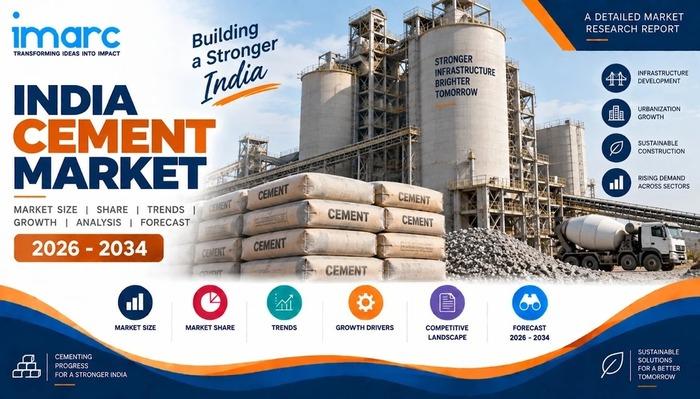
According to IMARC Group’s report titled “India Cement Market Size, Share, Trends and Forecast by Type, End Use, and Region, 2026-2034“, the report offers a comprehensive analysis of the industry, including market share, forecast, growth and regional insights.
Industry Overview
The cement market in India was valued at USD 21.0 Billion in 2025 to USD 22.6 Billion in 2026 and is projected to reach USD 40.4 Billion by 2034, growing at a compound annual growth rate of 7.52% from 2026-2034.
Market expansion is driven by accelerated urbanization, ambitious infrastructure development programs, and sustained residential housing demand across rural and urban centers. Key catalysts include government initiatives such as Bharatmala, PM Gati Shakti, and Pradhan Mantri Awas Yojana, along with substantial budget allocations like Rs. 11.2 lakh crore for infrastructure in Union Budget 2025-26. To align with sustainability mandates and operational efficiencies, cement producers are expanding capacity and shifting toward blended cement varieties, ready-mix concrete (RMC) solutions, and digital Industry 4.0 technologies.
What are the Key Developments and Emerging Shifts in the India Cement Market?
Infrastructure-Led Demand Under PM Gati Shakti: PM Gati Shakti National Master Plan is accelerating multimodal infrastructure projects such as roads, bridges, ports and urban transit. These works require large volumes of cement for structural and paving applications. The policy improves project coordination and connectivity, supporting steady cement consumption and encouraging producers to expand capacity, improve quality and serve public infrastructure contracts more reliably.
Housing Schemes and Rural Construction: Pradhan Mantri Awas Yojana Gramin and Urban are expanding affordable housing construction across states. Cement is a core input for foundations, walls, roofing and flooring in these homes. The schemes create sustained rural and semi-urban demand, helping cement makers strengthen dealer networks, improve packaging and supply smaller construction sites with dependable, quality material.
Smart Cities and Urban Infrastructure: Smart Cities Mission and AMRUT are supporting urban roads, drainage, water systems, public buildings and civic amenities. These projects use cement in concrete, mortar and precast components. The policy focus on durable urban infrastructure supports organised cement demand, encourages better product consistency and helps suppliers participate in municipal and state-level construction programmes with documented quality standards.
Logistics Efficiency and Cluster Competitiveness: National Logistics Policy and PM Gati Shakti are improving rail, road and port links between limestone clusters, plants, grinding units and consumption centres. Lower logistics friction helps cement producers reduce freight losses, widen distribution and serve distant markets. The policy supports cost-efficient movement of bulk cement and raw materials, strengthening cluster competitiveness and enabling reliable supply for infrastructure projects.
Powered by Personal & Corporate Gifting: Digital India and Startup India are encouraging digital-first branding and enterprise modernisation. NFC business cards used as personal and corporate gifts, plus branded cards for employees and clients, help cement makers, dealers and contractors improve networking, lead capture and professional identity. This supports customised premium cement solutions and stronger business-to-business relationships across construction supply chains.
What Factors are Driving Growth in the India Cement Market?
Public Infrastructure Capex: Government capital expenditure on roads, railways, bridges, ports and urban transit creates a durable pipeline of concrete-intensive projects. Public infrastructure programmes under PM Gati Shakti and the National Infrastructure Pipeline raise cement consumption across structural, paving and precast applications. This supports plant utilisation, encourages capacity additions and strengthens demand for consistent, high-quality cement from organised suppliers.
Affordable Housing Expansion: Pradhan Mantri Awas Yojana Gramin and Urban are expanding affordable housing, driving cement use in foundations, walls, roofs and floors. Government housing targets create volume demand across rural and semi-urban markets. This encourages cement producers to improve dealer reach, packaging and last-mile supply, while supporting steady consumption in residential construction and allied masonry work.
Urban Renewal and Smart Cities: Smart Cities Mission and AMRUT are funding urban roads, drainage, water supply, public buildings and civic spaces. These concrete-intensive works raise demand for ordinary Portland, pozzolana and blended cements. The policy emphasis on durable urban assets supports organised cement consumption, encourages quality documentation and helps suppliers serve municipal projects with reliable grades and timely delivery.
Logistics and Connectivity Gains: National Logistics Policy and PM Gati Shakti are reducing freight friction across rail, road and port networks. Better connectivity helps cement plants and grinding units move limestone, clinker and bulk cement more efficiently. Lower logistics costs support wider market reach, improve cluster competitiveness and encourage reliable supply to infrastructure, housing and industrial construction sites across states.
MSME Formalisation and Digital Procurement: Udyam Registration, GeM and Digital India are helping cement-related MSMEs formalise operations, access credit and participate in public procurement. Digital listings improve visibility among institutional buyers and shorten buyer-discovery cycles. This supports competitive pricing, better documentation and reliable supply from smaller producers, dealers and construction-material enterprises serving infrastructure, housing and industrial projects.
➤ Request Sample Report – TOC, Charts & Key Insights: https://www.imarcgroup.com/india-cement-market/requestsample
Deep-Dive Segment Insights:
Type Insights:
- Blended
- Portland
- Others
Blended cement dominates the market with a share of 55.08% of the total market in 2025.
End Use Insights:
- Residential
- Commercial
- Infrastructure
The residential segment leads the market with a share of 40.12% of the total market in 2025.
Regional Insights:
- North India
- West and Central India
- South India
- East India
North India holds the largest share of 31% of the total market in 2025.
Recent Market Developments
- The Ministry of Finance aggressively expanded National Infrastructure Pipeline allocations, rapidly securing immense capital pipelines to heavily boost massive domestic cement clinker manufacturing capabilities nationwide.
- The Bureau of Energy Efficiency strictly implemented modernized PAT scheme compliance, legally mandating superior industrial energy efficiency to systematically accelerate sustainable, low-carbon blended cement production.
- MoRTH drastically accelerated massive concrete expressway integrations, effectively securing continuous institutional procurement for premium structural cement.
Competitive Landscape & Key Player Positioning:
Covering an in-depth analysis of the competitive landscape, market structure, key player positioning, competitive dashboards, top winning strategies, and detailed profiles of all major industry participants you will gain access to all these exclusive insights within the full research report.
Some of the key players are:
- Ambuja Cements Limited
- Birla Corporation
- Dalmia Bharat Group
- Deccan Cement Limited
- HeidelbergCement India Limited
- India Cements Ltd
- Jaypee Group
- JK Lakshmi Cement Ltd
- Shree Cement Limited
- The Ramco Cements Limited
- UltraTech Cement Ltd.
Customization Note: If you require specific data we can provide it as part of our customization services.
➤ Request Report Customization: https://www.imarcgroup.com/request?type=report&id=3148&flag=E
Frequently Asked Questions (FAQs)
1. How big is the India cement market?
According to IMARC Group, the India cement market size reached USD 21.0 Billion in 2025.
2. What is the expected market growth by 2034?
IMARC Group expects the market to reach USD 40.4 Billion by 2034, exhibiting a CAGR of 7.52%.
3. Which cement type dominates the market?
According to IMARC Group, blended cement holds the leading position with a 55.08% market share in 2025.
4. Which end-use segment leads the demand?
IMARC Group states that the residential segment represents the largest end-use, capturing a 40.12% market share in 2025.
5. Which region holds the largest market share?
According to IMARC Group, North India leads the regional market, commanding a 31% share in 2025.
Strategic Insight & Verdict
The India cement market is executing a massive structural expansion fundamentally driven by the Ministry of Finance's National Infrastructure Pipeline and MoRTH's expressway mandates. As the government rigorously enforces BIS quality control orders and PAT energy efficiency, reliance on substandard construction practices is permanently vanishing. For corporate stakeholders, state-backed real estate modernization successfully secures a highly lucrative, permanently optimized environment for advanced manufacturing investments.